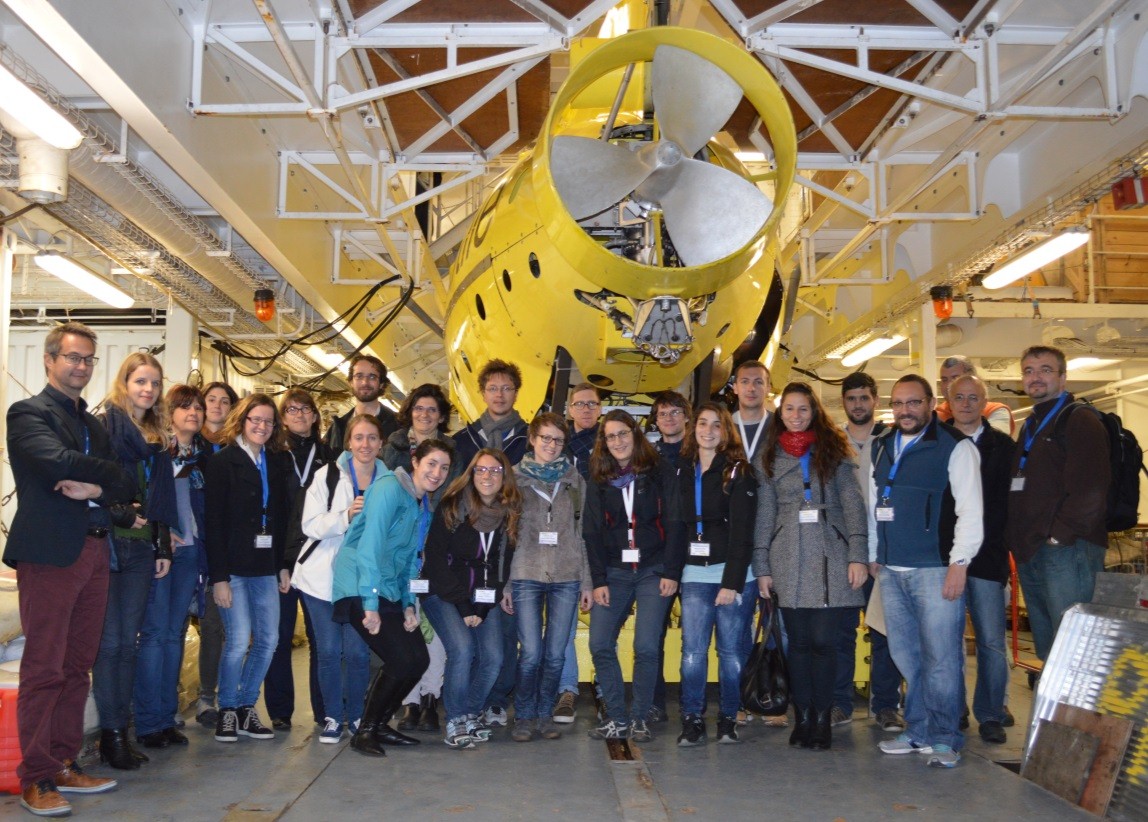
The visit to the IFREMER Center of La Seyne-sur-Mer through the eyes of the ABYSS fellows
Most of our land maps display the Earth in tiny detail. The ocean floor however is one of the more enigmatic parts of our Earth, but that does not mean it is less interesting. In the ABYSS-program, we all focus on rocks that come from the sea floor or are related to it. In order to find out how these samples are collected, we visited the Mediterranean site of the IFREMER-center on November 27th. This French research institute focuses on the exploration of the sea floor, from the water itself to the ecosystems at the seafloor and the rock masses at hydrothermal vent systems. Overall, the institute hosts five different centers and 25 locations along the coastline of France and French overseas regions. The Mediterranean center in La Seyne-sur-Mer especially focuses on the development of new and the maintenance of already existing underwater tools which must be adapted to work under high temperatures and, most importantly, high pressures.
Upon arrival at IFREMER, Gérard Riou, Director of the Centre IFREMER Méditerranée, warmly welcomed us. He gave us an overview of the importance of this particular area of study and its significance for the French and international research community. This was followed by a more detailed presentation by Jan Opderbecke, new head of the “Underwater Systems” Unit at IFREMER, on the different operational techniques which are available. Deep-sea investigation and its operational tools were discussed, ranging from simple torpedo-shaped gliders without any propelling device to the complete Nautile capsule, which allows 2 technicians and one scientist to go down and collect samples from the abyss to about 6000m below sea level. This pioneer research submarine started operating several decades ago, well ahead for the standards of research institutes of that time. The presentation allowed us to get an idea of the various types of data that can be collected and the way that underwater equipment works. Subsequently, we were introduced to ways of using this data for teaching and outreach activities, amongst other applications.
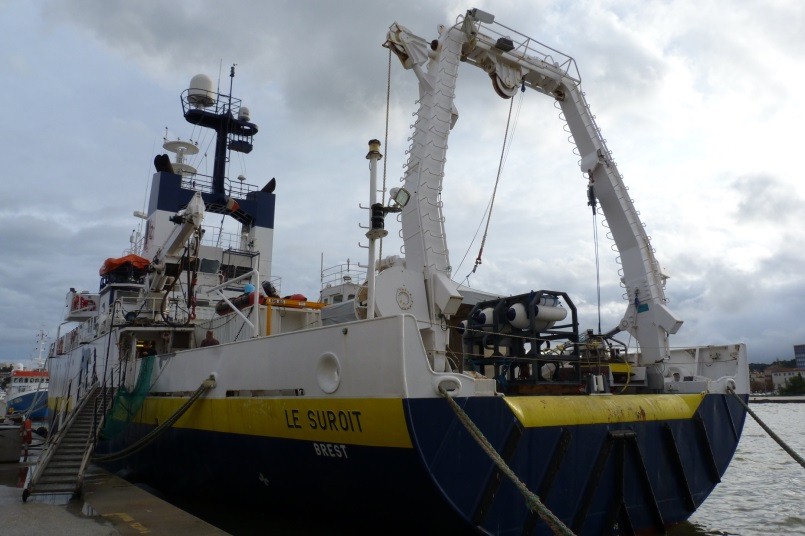
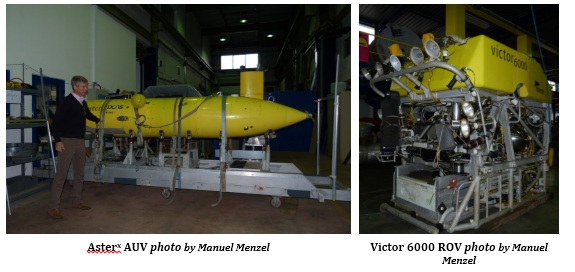 Then it was time for us to visit the research vessels and see the Remotely Operated Vehicles (ROVs) and other operational tools accompanied by Gérard Riou and Jan Opderbecke. First, we saw one of the smaller AUVs (autonomic underwater vehicles), the Asterx. After that we went outside to see Le Suroît, a small research vessel which is slightly over 56 m long. On this vessel the H-ROV hybrid device is being tested at the moment. This device is equipped with a camera and has two robotic arms to pick up samples. We were also able to look into the control room behind this machine.
Back inside the large maintenance hall we visited the Victor 6000, a larger, unmanned tool that can pick up rocks and collect water samples at depths of 2500-6000m. Also, some small gliders were presented, which can be left at sea for several weeks. Last but not least, we visited the vessel “Pourquoi pas?” in the harbor. This impressive research vessel is 10 stories high and about 107 meters in length. We were shown around the most important parts of the ship, including the Nautile submarine and on-board laboratories. We started our visit in the area where their ROV was stored, along with the whole equipment used to deploy it down the deep waters and onto the seabed. The next level contained several labs, which are especially used for immediate analysis of sampled fluids and water. Usually, these labs are adapted to the purpose of the cruise.
One lab is reserved for rock samples, where scientists can have a first look at the samples and make a short description of it. On our way to the bridge, we passed by the living area of the ship which included a restaurant and cabins with bunk beds. After crossing some bridges and walking up staircases we arrived at the science control room, where data is gathered from the seabed such as bathymetry and sonar imagery. In this room geoscientists and the “Pourquoi Pas?” crew work together to obtain the best results for the research expedition. Lastly, we arrived at the bridge which is elevated and strategically located at the front of the vessel to serve as viewpoint. From there we looked onto the port of La Seyne-sur-Mer, delighted at such a magnificent view. The room is equipped with positioning, navigational and communication resources for the captain and his crew to sail the “Pourquoi Pas?” to the most remote places in the middle of the ocean. We were really impressed how well this ship is equipped. The visit has made us wonder how it would be to work on such a ship!
New equipment and software is developed every day, and IFREMER is at the cutting edge of research and technology for deep-water manned and unmanned vessels. Their equipment is available to the whole scientific community, ready to be used for purposes such as the research being conducted within the Abyss framework. Seeing this equipment makes us realize how little we know, and how much is left to discover!